11.01.2012

From Buddhist Psychology, again:

The Still Center
 
           This evening I went running at dusk, through quiet neighborhoods that smelled crisp like winter and rich like the decay of autumn. For a moment, as I moved, I think I understood something, in a full-being way of ‘understanding,’ like pañña. It might have been equanimity, but I’m not sure. The hush of falling night slanted with the falling season, and emotions barreled through me as I ran: poignant nostalgia, inspiration, longing, bliss. I watched feelings and images storm through my mind and my belly. It was like cinema—I didn’t own them and they were beautiful, and then they left. I kept running. I felt the rhythm of my feet falling, and my breath. Winter’s bite, leaves rotting in gutters, incandescent clouds.
            This week I have playing with the ideas of equanimity and intimacy. For a long time I’ve had an instinctual aversion to the Buddhist idea of equanimity (upekkha). Like many Westerners exposed to Buddhism, the concept of equanimity often strikes me as dry and disengaged. I love the ups and downs of my experience; vividness and feeling are so real. The tranquility of upekkha seems like a dangerously uninspired flat-line. According to the description of equanimity in the Anguttara, for example, a person who has experienced a sense impression from the world or formulated a mind-object should be “neither glad-minded or sad-minded,” and should “[abide] with equanimity, mindful and clearly conscious.” How can I move through the absurdity of my human life and not feel glad or sad? Isn’t the meaning in all of these passing moments to be found precisely in my corresponding internal states of exaltation or poignant sorrow?
            If I shift my understanding of ‘emotion’ and ‘attachment,’ however, I am much more willing to nurture upekkha in my everyday life. In my instinctive interpretation I tend to think that equanimity, in its extinguishment of desire and aversion, somehow lessens my engagement with the events of my human experience—it previously has seemed to me that the abode of equanimity is a cool internal sanctuary, separate from the texture of life that I love. This week in the still fall evening, however, I was able to refashion my understanding of equanimity. Instead of seeing the state of upekkha as one of disengagement from reality, I felt it as surrender and an acceptance of the way that the world truly is. When I identify with a feeling of sorrow, for example, or cling to a passing wave of euphoria, I am distorting the fabric of the moment with desire and delusion. Maybe the abode of equanimity, instead of implying an abandonment of my emotional engagement with a moment, denotes a sort of surrender to reality. Maybe it means that I should simply recognize the complexity of my experience of each moment and then let it flow through me like water. In this way, I can let go of my need for control and engage with the events in my life with more presence and intimacy. It’s like standing at the eye of the hurricane, with the space to truly appreciate the strength and grandeur of its gyre, and with the presence to be plied by wind and keep moving.
            I’m not entirely sure what the Buddha himself would say about this interpretation of upekkha—I am still deeply committed to my emotional responses as spicy and integral to the roller coaster that I love. But maybe a certain quality of observation will allow the ups and downs to flower more organically, and for me to see them and love them and release them, moving forward with poise and compassion.

10.22.2012

slant afternoon
falling gestalt of glowing motes

disintegrating
in cold gold live light --
foliage (moments) hinter-spinning
away from home on starling wings
too beautiful
these cries for still water
and remembrance

10.06.2012

Five True Things

Last night I biked across the river and through the crisp fall night to Brookline, where I met my friend Liz for coffee and poetry. Liz had just listened to this podcast -- in it, a young poetry teacher encourages her students to list five things that they know are true. You're not supposed to think about it too hard, just write the things that pop into your mind. It can be what you ate for breakfast, or how your fingertips feel.

So we thought we'd try this. We sat with our journals and wrote true things in three minutes or less. Afterwards we surveyed our lists, and were intrigued by the truths that flowed out of our pens. "Caitlin, I don't know if I get your truths," Liz said, "they're so abstract. What if you tried giving examples of each one?"

It was a lovely experiment. Five truths listed quickly, over coffee, somehow freed from the heaviness that the word "truth" can carry. Each truth with three corollaries. I recommend that everyone try this.

Here's my list: 

(1) Everything is made of dreams, light, and something else.
       a. autumn foliage in new england
       b. choices
       c. stories

(2) Objects are loveable.
       a. my blue coffee mug
       b. pens of all kinds
       c. Shiva the teddy bear

(3) Moments are deep.
       a. this one
       b. and this one
       c. this one too

(4) Bridges, mountains, steeples, and lightning have something in common.
       a. "A Noiseless, Patient Spider"
       b. eye-contact
       c. love

(5) I am more than my thoughts.
       a. the weather in my chest
       b. intuition
       c. collar bones

10.01.2012

Written for Buddhist Psychology:

Karma and “Faith”

The equinox has passed and the trees are just starting to catch fire on their tips –
colorful reminders that the world is changing and turning. This is, of course, always the
case, but during the last few weeks the whirl and disorientation of transition has been
more acute than usual. My first semester of graduate school is picking up speed, and in
the fervor of work and thought it’s been easy to lose track of the fine thread at connects
my many ‘selves’ through time. Many things seem uncertain. From my academic
interests to my trans-continental relationship, the tenets of my life seem terribly fragile,
almost whimsical in their constructedness.

In this context of indeterminacy, abundant decisions, and almost suspended
selfhood, I’ve found it very interesting to weave the Buddhist idea of karma into my daily
life this week. Broadly speaking, karma means “action” – it was interesting to realize that
much (if not all) of the pain and confusion I’ve been feeling through a time of transition
has to do with deciding how I will act, both in a moment and in the long-term: How am
I going to budget my time? Which classes will I take? Who will I commit to, and how?
What do I want to do with my life? The idea of karma, which melds intention, action,
and result into a single concept, sheds light on the decisions I must make in the midst of
indeterminacy.

Particularly, I found it helpful to shift my attention in my action from external
reality (the circumstances and the result of my actions) to internal reality (the way
that I approach my action in each moment). I found that there was a lot of power and
comfort in surrendering control over circumstances and outcomes. When I look more
internally at my approach and reaction to my action, the question shifts from “What do
I want to do in my life?” to, “What kind of person do I want to become?” This shift in
perspective actually resonates strongly with an argument that Professor Ellen Langer (in
the Psychology department) was making in a class on decision-making that I sat in on
at the beginning of the semester. According to Langer, “cost-benefit analysis is always
retrospective,” “stress is caused by the idea that we have supreme control over the events
in our lives,” and “more and more studies are showing that planning is out.” In social-
scientific terms, Langer was advocating this same turning of focus from circumstance and
outcome to intention.

In our discussion of karma, the idea of confidence or faith (I believe the Pali
word is saddha) was particularly compelling to me, and subject to some internal
experimentation. It makes sense that a surrender of the need to premeditate and control
events and outcomes necessitates an internal state of trust. Particularly, I loved thinking
about “faith without an object.” Therefore, this week, I have tried cultivating faith or
confidence as an attitude or emotion, rather than a transitive state. I have found that,
when I am successful, a difficult moment can be completely transformed into something
positive. Rather than being paralyzed by mutually exclusive options in a network of
stressful decisions, I am able to move through a sequence of events and just… trust. Trust
that the moment is ok, and trust my future selves to deal honestly with future moments. I
hesitate to use words that are charged with Western religious connotations, but I sense a
profound grace in that attitude of faith.

As I move through these transitions, it has thus been very helpful to remind
myself that, despite the fact that I can’t fully anticipate and control circumstances, this
spinning, wobbly clay pot of a ‘self’ that I inhabit is easily plied through intention. I
will continue to remind myself that an attitude of simple, object-less faith can transform
my doubt and stress into a strange, irrational confidence that facilitates movement and
growth.

6.05.2012

The Book of Changes


The sky broke open the day I left home—my mom and I bound up my life in packing tape as the lights flickered and the storm grumbled overhead. We held up an umbrella against the blowing rain on the exposed Amtrak platform, hugged and kissed goodbye, and then I boarded the train alone.

My neighbor had chuckled as we were loading up the car with my worldly possessions. “Well, here’s to another chapter,” he said, “Which one is it now? Have you lost track of which one you were on?”

Yes, Larry, I think I may have lost track of the chapters. I graduated from college, I went to South America, I came back, and then I dug my feet into my mountains and my home and my heartland. Somewhere along the way I pushed myself to stop pushing… I immersed myself in family and evergreen forests and love. I was still, less concerned with definition and demarcation. I blossomed.

And now it’s time for me to go. Although a part of me longs to stay sitting forever on the porches of Oregon with a cup of tea, another part of needs meaningful work. I want to understand my ambition and find a place for myself in this ridiculous world. I’m moving east, to Boston, to get a Master’s degree in Theological Studies from Harvard Divinity School.

So the train rocked me through misty, darkened mountains to Oakland, California, where I’ll be until next Saturday, when I move to New England. As I rode, the stormy wind in the trees sounded like the whispered ruffle of pages turning.


The painted hills, Central Oregon

1.14.2012

Still Here

It's been too long since I've written (sorry Grandma!). This is my life: I'm footnoting like a fiend, preparing one of my last essays for my graduate school applications. It's about the discourse between the rational intellect and the passionate emotional self. A discourse that I hope is possible. I turned 24 watching the sun rise; I was reluctant to see 2011 go. My motto for 2011 was "it's gonna be fine," but now I don't know anymore... AH. But recently I decided that 2012 can be "year of the wonderful,'' at least on certain days. I was admitted to river rafting guide school, and now officially plan to spend the spring and summer making the river my guru in Sequoia National Forest. I'm working as a "medical records technician" in my hometown of Eugene, Oregon, which means that I listen to This American Life podcasts while scanning images of people's kidney stones. This is in addition to my internship with the Eugene Weekly -- of late I have written about flying squirrel populations in the Pacific Northwest. I drink too much coffee, but that's not new. I read, I sleep (sometimes), and I laugh -- I've also been noticing absurdly beautiful atmospheric projections with strange regularity. I can play two chords on the guitar and I strum them when I have writer's block. I like hot toddies. I am itching for movement and I'm greedy for the whole universe, but I'm trying to be satisfied. This is my home. These are my roots. I love the rain.

1.13.2012

January's process is ice, and 
the knobbed oak branches have halos at dawn.
I love too much, I think, and I use a shovel to splinter
the frozen water troughs before driving to work, 
before impressing the things I cannot say onto a
translucent sky. The mist fell last night
while water dripped from every sink in the house
and I listened. The morning is silver and yellow
and I'm walking on fallen mist, longing to
be refracted as the dog's exhalations
glow with greed and life. Cracks scatter quickly 
across the thin ice -- synaptic transmissions
or Buddha fingers, or escape. This 
is the beginning. Every delicate thing has a
glistening edge. The light is growing.

12.18.2011

Delays, delays...

You can learn a lot about the human condition when your flight boards, and then, and hour and a half later, is cancelled. Things become fierce as you form an infinite cue with your co-travelers for flight re-scheduling. You realize how hollow and tenuous optimism can be; you tread the far-reaching borderlands of compassion.

I stood obsequiously aside as a first-class passenger harassed a bedraggled Delta agent. "I paid a thousand dollars for this ticket!" he shouted, "Serve me first! I must get to Minneapolis." Later he trolled the Line of Eternity asking everyone to confirm that the agent had been unacceptably rude. I wanted to look at him and say, "I'm sorry, Sir -- despite the fact that we live in an unfortunately capitalistic hegemony, it makes sense that the employees of the airline do not stratify our humanness in terms of our income and our willingness to spend. Your tie is overly pressed and not flattering."

I did not say this. Instead I took a sip of my coffee and tried to feel serene and glad that I wore my festive holiday sweater. Now I get to hang out in the airport for nine hours. If anyone ever wants a detailed description of the A Terminal of Boston Logan, I will gladly draw you an interpretive, artful sketch from memory. 

12.15.2011

East


I am in New York City, sipping a latte in a hip coffee shop with a preponderance of mirrors and shafts of light shining artfully through bottles of vintage wine. I just submitted my first graduate school application.

I flew to Boston on Sunday to visit Harvard's Divinity School, and now I'm in New York to eat some bagels and realize my dream of ice-skating in Central Park whilst wearing a billowing scarf. So far I've spent a lot of time taking trains in the wrong direction on the underground. Also, my dear friend Kai and I split a pitcher of sangria last night and wandered the parks and streets of this place, pondering how the myth of a city can affect our experience of a particular tree.

It was fascinating to visit Harvard -- it feels absurd and audacious that I would consider that institution (speaking of myth), but their Religious Studies program is full of inspiring people that I would love to work with, so I really can't resist. That does not mean, however, that I was not thoroughly intimidated by the vast numbers of chandeliers and shiny shoes that I found on campus. It scared me somewhat, all of the history and the opulence and the ego. I walked through the historical architecture of Harvard Yard, dwarfed by monumental panes of stained glass and old stones engraved with Latin phrases that struck me as foreign incantations. I felt a deep pain in my chest when I compared the steeples and the slate-gray sky to my home in Oregon. If I were to study on the East Coast, I would be so far away from the forest and the mountains and Eugene.

But then it was three o'clock, and the bells tolled the hour, beautifully. There's a circular labyrinth outside of the Divinity School that's shaped exactly like the one that I know on Orcas Island at Indralaya -- I stood at the heart of the winding paths and used every fiber of my being to bind New England and the Ivy League to the salt-smell of the Pacific.

I met with a professor that teaches an entire class on eye-contact. She works with prison inmates, studying the way that Buddhism and Neuroscience can be integrated and then taught to prisoners in such a way that they can live free, meaningful lives behind bars. I remembered that I read a book by Thich Nhat Han when I was an exchange student in Chile. The monk is writing for prisoners of all sorts, from the literally incarcerated to those ensnared in the inevitable constraints of civilized culture. He says that, if you feel trapped, you should listen for bells, because every bell means that you're free, no matter where you are. Since then I've always been listening.

I'll be back home on Monday, to feel festive and celebrate my 24th birthday on the 24th of December. I will no longer be prime, but rather very highly divisible. I'm kind of excited to find out what that means.


11.16.2011

A different perspective:


...TICKTOCKTICKTOCKTICKTOCKTICK...

That constant heartbeat of a noise, like an unending polka danced by an obese woman in stilettos, had been pounding rhythmically ever since anyone could remember. Even though each beat created a minor aftershock in the clan's wall space, it faded into the background, an unquestionable element of life. Like ear mites.

Unquestionable, that is, until Simon stuck his whiskers where no mouse should tread. 

"Dad," he squeaked on an otherwise routine Tuesday, "what is that sound? Do our walls breathe?"

Monohan Mouse, Simon's distinguished father, regarded his son condescendingly. "Don't be silly," he said with a nervous twitch of his tail, "our walls are inert, nothing more than a delineation of our world. You mustn't think of such things."

Had Simon possessed any sort of sense, he would have left the matter at that and continued along the well-oiled family tradition of caution and prodigious replication. He had always displayed a perilous propensity for pondering, however, and we all know that young mice lack sense.

As a result, that previously inoffensive Tuesday raised it's fists for combat and prepared to go down in history. Simon (that little rascal) disregarded his father's sage advice and got ready to Leave. 
Vamoose. 
Pry at the Gaps. 
Escape.

...TICKTOCKTICKTOCKTICKTOCKTICK...

Simon's ears quivered as they searched for the source of the cadence that had heretofore defined his existence. It somehow seemed to come from all directions at once. Well, he told himself, I have no choice--he would have to violate every moray of mouse-hood. With that thought, the errant son attacked the wall tooth and nail. His fellow rodents barely had time to gape in horror before the tip of his tail slithered through a gnawed perforation in the the wall. 

"He's a goner," rasped cousin Edna. 

Simon was a world away from his petrified family, however. He emerged into glaring light that poured down from an impossible height. The light glinted off of an equally expansive floor. Simon would have been faced with an uncontrollable urge to zoom a zamboni across that gleaming surface, had he known what a zamboni was. Instead, his heart caught wordlessly in his throat. What was this blinding place of forever dimensions? For the second time in a single Tuesday, Simon confronted just one option. The little mouse made his reluctant way across the foreign ground, the click of his nails producing an dissonant echo.

...TICKTOCKTICKTOCKTICKTOCKTICK...

It was getting louder. Simon's exhilaration blended with the sobering realization that, for the first time in his life, he was alone. Just as his doubts were beginning to put a stutter in his gait, he saw It:

It was like nothing he had ever seen before. It towered almost to the limits of his vision. Its wooden sides reflected the glimmering mist of the forest from whence the cleft wood came. Simon did not know what a forest was. Its glass doors contained an entity that seemed to dance with Its rhythm. Simon could not discern its true shape. Its face... Simon couldn't see its face.

...TICKTOCK...

The mouse ran up the clock.

11.14.2011

La La Land

So I made an interesting discovery about two days ago: one of my graduate school applications is due in just four weeks--an entire month earlier than I had planned. Eeep. I needed to rapidly come to terms with several highly stressful states of affairs, given that I really want to enroll in a master's degree program starting next fall. Unquestionably, the largest source of my newfound stress was the GRE (the "Graduate Record Examination" is pretty much the grad school equivalent of the SAT). After a frantic and barely-intelligible conversation with an outsourced exam scheduler in India, I discerned that the only way for me to take this exam in time for my deadline was to have it proctored to me in Portland, today. So I forked over the $160 registration fee, and came to Portland.

Let me just say now that I think the GRE is a manifestation of everything that is wrong with the educational system. In fact, I will claim that the GRE is evil. I hate that I have to take this test; I hate that the schools I am interested in require me to take it. But. My conviction that I can carve a path for myself studying The Questions That Matter made me swallow my pride and submit myself to the exam. I entered a room full of computers and artificial light, donned the yellow noise-canceling headphones, and clicked and typed my way through four hours of bullshit.

I bought The Princeton Review's Cracking the GRE to help me study for this test. The authors have a hilarious, sardonic take on standardized testing: "If you find yourself in the math section with a half a page full of calculations and no answer, you are in La La Land," the Princeton Review told me. It then gave me a neatly bullet-pointed list of tips on how to escape from La La Land. And, indeed, there was a moment today today when I was wandering a quagmire of calculations, and I was like, "Oh no! Caitlin! You are in La La Land!" I forgot the bullet-pointed list, and laughed out loud at the hilarity and hopelessness of La La Land. Then the test proctor came in and told me not to disrupt the testing studio. It was great.

But really, I survived. I actually finished the exam 45 minutes early, walked out of the Computer Lab of Exam Doom into an invigorating autumn downpour, and heaved a sigh of relief. Now I'm rocking gently on the train back to Eugene... Take that, Mr. Man--I can take your tests, and they do not daunt me. I may not get the best score in the world, and I may spend a portion of my life floating in different dimensions of La La Land, but I'm going to try with everything I've got to figure out this "Grad School" thing.

11.08.2011

Employment

Since I've been back in Eugene, I've have to confront the inevitable fact that I need to find a job. It's really been fascinating a experience, given that I've spent the past five years of my life using every single resource I possess to evade the so-called real world. And by "fascinating," of course, I mean "ego-shattering." Getting a job necessarily means that I will be rejected again and again--probably upwards of millions of times in this economy--before I succeed. And I have not yet succeeded. I sent an e-mail to eight professors at the university asking if they needed research assistance, and six of them politely rejected me in just one hour. Two responses to my inquiries have been scams, and I will never forget how blatantly dismissive a manager of a café became when I told her that I didn't have any experience as a barista. Even worse, perhaps, is the silence. I've spent a fair amount of time in the past couple of weeks wondering what will become of the resumés that I have dropped off at local businesses. Will they slowly rot in forgotten drawers alongside the resumés of a thousand other job hopefuls? Do managers and business owners crumple their innumerable useless resumés with a wry chuckle? Maybe their laughter is maniacal. Maybe they actually eat the resumés.

There was a low point today, after I picked up a job application at community credit union. Everything felt bleak--not only was I considering working directly for the Man who fabricates the illusion we call "money," but I also needed to buy a watch. (My watch broke a few weeks ago, and I had taken it as a sign that I was free of linear time... but now it's become apparent that I actually need one to keep appointments and such things.) So I was marketing myself to a bank, I was shackling myself into time, and it was also starting to pour so that the ink ran on my warped resumé. Bleak indeed.

But then, when I started the engine of my car, this is what was coming out of the radio:

"Music is on the radio – I notice that as I listen, I think of my mistakes, ill words, wasted time, and the next note I think of who I love and who I hate and the success I've had at both and of my tomorrow's chances. And I feel like a singing god riding on a cloud snapping my fingers and ruling a universe."

Pete Seeger spoke with deep reassurance as he strummed his banjo, and I remembered that I love the rain. I remembered that I chose to come back to Eugene because this place is my home. I am not trapped--even in this conventional urban 'wasteland' there is music; an intensity of the human spirit that makes my skin crawl. Here there a long conversations over coffee, mountains, community, and my family. I am always free, wherever I am. 

Maybe I can face the job market tomorrow. Reject me, I dare you.


10.31.2011

Danyo's Bowls

There was a silent meditation retreat during my last days at Indralaya. About 15 people partook, and it was perfect to end my time on the island in an atmosphere of deliberate silence. 

The meditator who I will remember most from the retreat was a Somalian man named Danyo. His complexion was so dark that it was almost purple, and he wore loose white robes. He walked slowly, with a sort of hulking grace. Before the vow of silence was taken, Danyo told a story about how he sustained a compound fracture in his upper arm running from a hippopotamus in the swamps of Somalia. 

The first evening of the retreat we all gathered in the library to enter into silence together, and Danyo unveiled his bowls. He had seven bronze bowls of various shapes and sizes. Wrapped lovingly in burlap, they were nested inside of one another like Russian dolls. He took them out one by one with an astonishing gentleness, and arranged them around his folded knees. And then he told us the story of his bowls.

Danyo told us how he moved from Somalia to Manhattan, and then got a job as a taxi driver. One day, when he was driving around the city, he passed a shop that was owned by a Tibetan couple--it sold traditional Tibetan items like thangka paintings and incense, and Danyo was immediately attracted to the place. That very day he parked his cab and walked inside. "It was like I was going home. I loved the bowls as soon as I saw them," he told us. His accented voice was rich and sweet like honey. 

Over time Danyo saved enough money to buy his bowls. Now he knows each of their voices like they are his brothers. He calls himself the steward of the bowls, and he lives only to let their singing lead people toward truth. To begin our silence, he rang the largest of the bowls. He struck the thick brass with a wooden mallet again and again, and I could feel the deep ringing in my chest. This was a sound that a whale would understand; a sound that a mountain might utter over the course of eons. And then everything was quiet. 

Now I'm not exactly sure about my status on reincarnation... I tend to believe very little, but lately I've been trying to remind myself that believing nothing gives me the space to accept everything. Why shouldn't Danyo be a reincarnation of a Tibetan lama? It really would make perfect sense. It reminds me of a conversation I had with a Romanian Religious Studies professor that I met on the train in Tibet, when I was leaving Lhasa. After briefly discussing the clouds and their meaning, this middle-aged Romanian woman relayed to me her experience in a Tibetan monastery. She told me how, upon entering the walls of the monastery, she immediately fell to her knees and dissolved into tears of joy. She told me that, before that moment, she had never felt like she belonged anywhere.

Why not?

I left Indralaya at dawn, before the silence was broken. The sun rose as the ferry bore me across the sea to the mainland. It's sort of a scary thing, "the mainland." It's a land of job markets and graduate school applications; a land where I could see the Bellingham oil refinery belching out plumes of dirty smoke over the Pacific. But we all have to return to the mainland, I guess. We have to take the peace and light that we gather on our respective islands and bring it home with us, bottled up somewhere inside of us. We have to share it to the best of our ability, cuz it's far too easy to get lost in the fog. At least that's what I'm trying to do. 

When I focus I can still let myself hear Danyo's largest bowl resonate. Or at least I can still imagine the vibration, somewhere near the pit of my stomach.


10.10.2011

Written for an Indralaya Publication:


I grew up coming to family camp at Indralaya with my mother and brother. I vividly remember the sense of magic that permeated my experience of this place: we would always stay in Apple Cabin, and the carpets of my secret workshop that I built during guided meditations were deep purple. All year long I would look forward to painting my nails for the Sock Hop, or watching my intricate beach mandala vanish in the tide. That was back when I thought that “ferry” and “fairy” were the same word. It was easy for me to see the halos around trees.

A decade has intervened since my last visit to Indralaya. I started High School and then I graduated; I enrolled in college and emerged with a degree in Religious Studies and Neuroscience. I’ve studied in Egypt and Turkey, taught English in Tibet, practiced Buddhist meditation in India, and hitchhiked across South America. I’ve engaged critically with the questions that I find beautiful, been lost and confused, and grappled with the implications of my own freedom. I don’t know about “growing up” but I’m twenty-three now. I’m striving to carve out a place for myself in a chaotic world.

And now, ten years later, I have returned to Orcas Island to spend six weeks at Indralaya as an intern. And it’s beautiful. Again. I meditate in the morning, comparing bells with gulls and remembering the limitations of my analytical mind. I’ve laughed in the basil patch, made gallons of pesto, and stuck my face into plum trees in search of their perfect purple fruits. There have been moments where time collapses, and where I sense the presence my childhood self—the girl who believed that anything is possible. After being swept away in a whirlwind of continents, résumés, and unanswerable questions, it is so relieving to plunge my hands into freshly turned earth and breathe.

Of course my path is still loosely defined, and my thoughts still get the better of me. But my hands are stained with beet juice, and the other day I watched bioluminescent lights kiss and spin in the nighttime ocean. I’m remembering exactly how deep a moment goes. Although many years separate me from wide-eyed childhood wonder, Indralaya continues to be a beautiful place for me to plant my feet and remember my spirit.


9.29.2011

What now, T.S. Eliot?

Do I dare 
Disturb the universe?
In a minute there is time
For decisions and revisions which a minute will reverse.

...so asks T.S. Eliot, in his poem "The Love Song of J. Alfred Prufrock." And I, in turn, ask myself, "Do I dare?" This question can mean so many things. When is a risk beautiful? What is freedom? On how many levels can one rattle the foundations of this universe and perceive new inklings of beauty?

I'm musing about Mr. Eliot because of Major Life Decisions, unsurprisingly. I'm musing because I just decided not to go to Alaska. I decided instead to move home to Eugene, Oregon and overwinter conceivably close to my family, listening to the sound of rain. "WHAT?!?" you ask, "Is this the Caitlin I know, the Caitlin who climbed an Egyptian pyramid in secret and stalked alpaca in the high Andes?" I dunno... the Buddha said that the self is an illusion. I just know that I'm not quite sure what "home" means anymore, and that I've been running for a long time. I know that after I bought my plane ticket to Alaska, things just didn't feel right. I've been to the plateau of Tibet and, spurred by some intangible itch of the soul, sprinted down the Friendship Highway through a nighttime thunderstorm. Everything has been preposterously beautiful, but I feel a bit lost and I can't pinpoint what I'm looking for. Yesterday when I was breaking up clods of earth in the garden beds it occurred to me that I need to be grounded for a while; to get in touch with my roots. 

So I'm going home. 
"Home."
Home?

...to the rain. The Northern Lights will wait.

Time for you and time for me,
And time yet for a hundred indecisions,
And for a hundred visions and revisions,
Before the taking of a toast and tea.

9.26.2011

Geography and Other Frontiers

There is something inevitably metaphorical about islands. I mean, to get to the island where I'm currently living, I have to board a ferry and motor across buoyant sea-scapes and gleaming clouds. Then, when I disembark, my feet encounter something new. The secret coves with their purple and orange starfish, the fragrant forests, the gnarled orchards drooping with fruit: they are beautiful in their own right, but, beyond that, they're gleaming with luminous ideas. There's more space here for people to bring their far-flung notions and bring them to life (or cast them out to sea). There's a fierce independence to islands, like their making some sort of noble last stand against the corruption of civilization. I feel like I'm living on a real frontier. And the stark geography can push me to the boundaries of my mind.

Today I walked with some friends down the beach through a fierce gale. I wore rubber boots and tromped through the seaweed while the wind ran like vast invisible herds of horses over the surface of the Pacific. It's fall here now, suddenly--the blustering wind felled pine needles and apples by the dozen. This morning I made the sad discovery that most poems about autumn are terribly preoccupied with mortality. Poets love to muse about fleeting moments and impending frost in the fall. They talk a lot about final flairs and shadows. But I dunno, even in the rain storm I felt a beautiful golden texture to the turning of the seasons. Yesterday I plucked a ripe fig from the orchard, and today I pulled perfect smooth clay from the seaside. Both were malleable and fleshy, earthbound, beautiful. I'm not quite sure what I'm saying. There is still clay under my fingernails, and the fruit is ripe. I feel optimistic about autumn.


9.18.2011

Pesto and Walruses

So I made 68 cups of pesto. If you are curious, 68 cups is equal to 4.25 gallons. I realize that this is a great feat, and I am proud. In Wisteria, the cabin where my friend Kendra and I reside, you can still catch the occasional fragrant whiff of basil.

It is worth mentioning that I met Kendra at a national park in Patagonia (for a reflection on that experience, you can glance at this post from the archives). We last parted ways in Bolivia, and then I sent her this e-mail saying, "So I'm going to this island in the fall... wanna come?" And, miraculously, it worked out. I picked her up in Seattle and now we're here, unfathomable latitudes from our meeting-place, laughing in the basil-patch. And we also happened to meet a bunch of Chileans on the ferry and practiced our Spanish in the open water at ridiculous odds.

Being back at camp Indralaya is beautiful. It's been exactly a decade since I was last here, and I can feel the presence of the past selves of my childhood here--the Caitlins that believed in magic. I've been meditating every morning with the resident managers and my co-volunteers, listening to vast silence punctuated by the occasional airplane or soulful loon. I've been thinking a lot lately about the crazy mental barriers we so often insist on building... you know, barriers against freedom, or magic, or love. I've been thinking about breaking them down.

Oh and NEWS FLASH: I've been informed of an unfathomably exciting volunteer opportunity. Apparently a marine wildlife rescue center outside of Anchorage, AK is currently seeking volunteers to spoon with baby walruses. I am not kidding. There are baby orphan walruses that need humans in walrus suits to cuddle with them. I'm currently scheming ways to incorporate walrus-cuddling into my Alaska winter. It just makes sense.

9.12.2011

Forward ho!

So after a bit of a hiatus, I've decided to resuscitate this narrative. Because I'm a million percent convinced that I can find something beautiful in every moment that's worth writing about and reflecting on. And, of course, my life continues to be ridiculous. I'm trying on questions and lifestyles like so many hats; traveling still; trying at once to figure out my future and rejoice in the present moment. Reminding myself that bewilderment is sacred.

So here's the lowdown of what has happened in the four month gap since I last wrote: I flew from Peru to Minnesota, where I visited Carleton for about a week, and then I flew to Seattle and took the train down the Pacific coast to my hometown of Eugene, Oregon. There I used my dwindling funds to purchase a car (a 1995 Subaru, Delilah), and proceeded to drive down the interstate to my summer job in the mountains of Southern California. After spending 11 crazy/wonderful weeks working with kids and reveling in starlight, I drove back up to Eugene by way of San Francisco, said "Hey," and then promptly filled Delilah's trunk to the brim with anything I could possibly ever want and drove up to the San Juan Islands in Northern Washington. I'm currently living on Orcas Island, working at a beautiful camp where I used to come when I was young. I'm making pesto, drying plums, eating ripe figs off the tree... and in my spare time applying to graduate school. Days ago I accepted a job working with sled dogs in Alaska for the winter, and that's another adventure looming on the horizon. The Northern Lights.

The other night I was sitting at the beach at Indralaya, the camp where I'm working, with my co-interns. We watched the sun sink and the almost-full moon rise, marveling at the way celestial reflections slither on the ocean without ever moving. Then, one by one, bioluminescent particles came to life in the tides. The little lights were a violent shade of aqua, and they darted about almost playfully -- they kissed and swirled, and then, without warning, extinguished. I've had Joni Mitchell's "Circle Game" stuck in my head incessantly since my arrival on the island, and I can't get over the smell of things. I'm excited about everything unfolding (with a healthy amount of fear and confusion for spice).

So that's that. It's all boundless, and I'm writing again. Stay tuned for stories.


5.10.2011

...and then we flew.

Cuzco and Maccu Picchu were a story of impossible, ancient mortar. That is to say, the Incas did not use mortar. They used magic. After a 12 hour bus ride (in which more than one pickle per hour was consumed) Nathaniel and I excited Bolivia for good (only one day over the visa limit!) and arrived in the ancient capital of the Incan empire. There was a peculiar misty light in Cuzco, which strangely seemed to sharpen the edges of things... and many stairs. Many, many stairs. 123 stairs to get to our hostel, in fact. Magic mortar mingled with modernity on the city streets, and we enjoyed museums and wandering and markets.


And then we journeyed to the iconic ruins of Maccu Picchu. We did the Extreme Budget Version (total cost: $100). This is what the Extreme Budget Version of Maccu Picchu entails: On the first day we awoke at 3:42 a.m. to take a series of harrowing taxi rides to a hydroelectric plant in the middle of the jungle where we had to walk on some railroad tracks for three hours to get to the town at the base of the iconic ruins. Exhausted, we fell asleep at 7:00 p.m., only to get up the next day at 3:42 a.m. to sprint up 600 vertical meters of stairs to be the first people in line at Maccu Picchu so we can climb another mountain (i.e. more stairs).  It was crazy, but it was beautiful. We communed with llamas. Nathaniel juggled. I really have no idea what the Incas were thinking building a city up there with the clouds and lots of vertical cliffs, but wowzers. Even after so much travel I am still overwhelmed by these "postcard moments."


We splurged on train tickets to return to Cuzco, where we proceeded to treat ourselves to full body massages with hot rocks and pedicures for $15. That's right, my toenails are now something verging on hot pink. We finished Philip Pulman's His Dark Materials trilogy on a park bench in the pigeon-filled Cuzco plaza, I baked banana bread, and then we took an absolutely mind-numbing 22 hour bus ride to Lima. (I actually wanted to strangle myself with the complimentary blanket after we had to watch the ad about the award-winning prescription lens company for the 27th time... but we made it). 

And now we're in Lima, in a hostel overrun with delightful hippies that get by selling hand-made crafts. It smells unmistakably like the ocean here, and it's cuz the Pacific's only a few blocks away. We've run along the seafront in the mornings (so much oxygen!), seen an extremely excellent ancient library that monks used to use, and failed at visiting two museums (par for the course). And today is our last day in South America. Tomorrow we fly to Chicago... what? I really can't believe it. But rituals help. You know, Meaningful Things like blowing out candles or wearing robes. So, after some consideration, we decided to commemorate the past seven and a half months with flight.

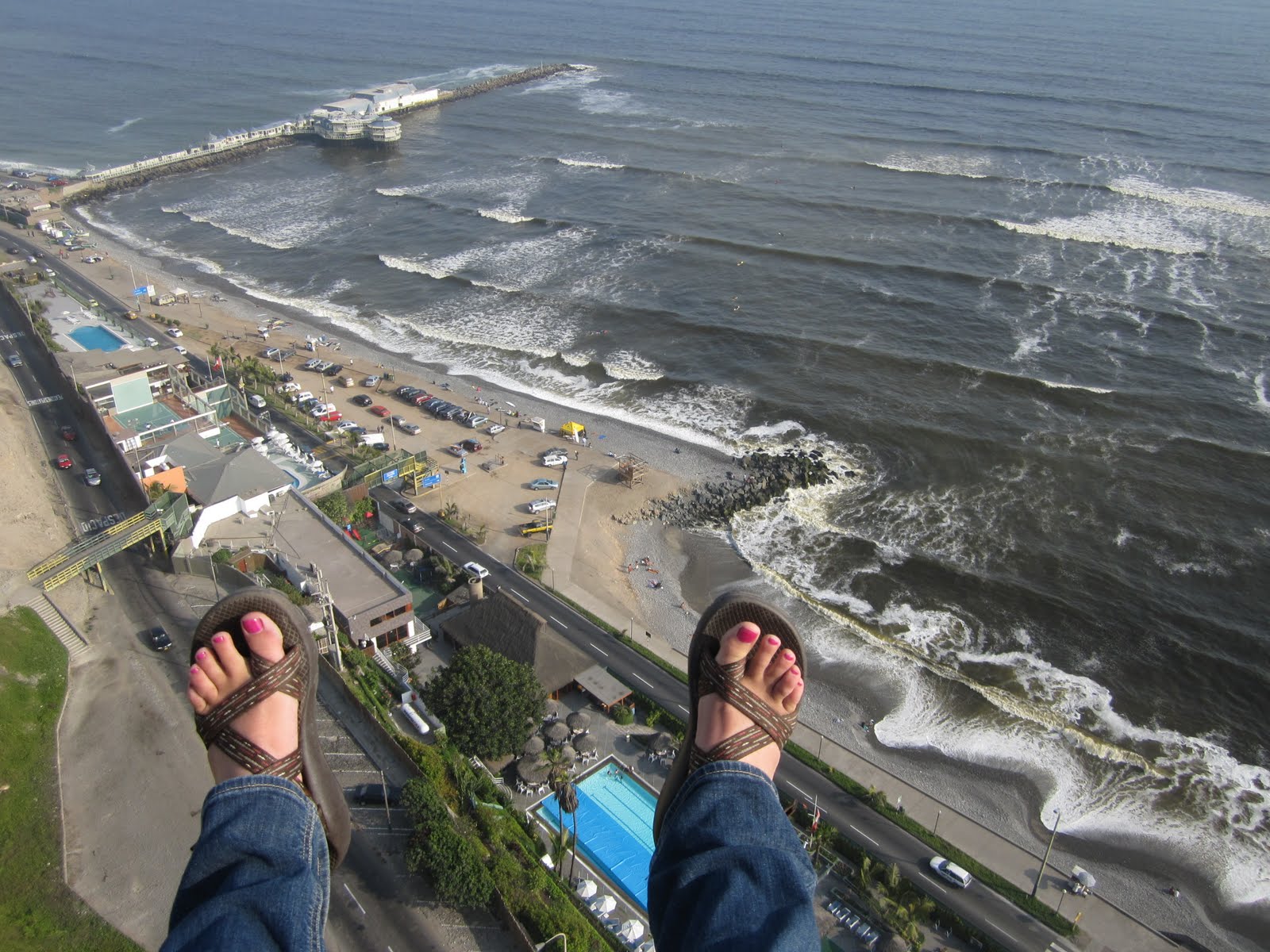
...and then we flew. Or more technically, paraglided (paraglid?). I believe that my experience of those 12 minutes--those moments spent hanging silently over the Lima coastline with my trusty parachute pilot Marcelo--is the closest I will ever come to understanding what it is like to be a bird. Every flying dream I've ever had merged with reality as I watched my feet soar over city streets and regarded premium Lima pent-house apartments up close. Walking is so bumbling and lame in comparison.


And tomorrow I get to fly in a roaring mechanical behemoth; a machine that will bear me back to my mother country. It really is strange. I find myself wishing  for something concrete to lend it all meaning... When Nathaniel and I finished reading The Amber Spyglass out loud, there was a whole page imprinted simply with two words: "The End." There were ornate designs squiggling above and below those words. It was almost monumental. How can you find that in life? I sure don't know. Instead of two clear words with text ornaments, I know that life will give me an overwhelming whirlwind of airports and friends and family and places, and that I will be left grasping for threads to orient me in the flood. I'll unpack my backpack, start thinking about my summer job, say goodbye to Nathaniel. Be confused for a while. But it has been beautiful. I don't know if I'll ever make sense of it, but I have flown. And I will fly. Tomorrow, and again and again.

4.30.2011

Coffee and Ancient Stones

So the coffee man never showed up to take us to the coffee farm. A harrowing taxi ride took us to the sultry jungle-town of Caranavi, but the second leg of the trip never quite connected... This is actually pretty par for the course for Bolivian logistics--with more time, of course, we could have figured out how to get there eventually, but with only eleven days until The Return to "Reality" (AH) we just didn´t have time. We did, however, get to spend an interesting 24 hours in the metropolis of Caranavi, which was nothing like any Bolivian city I have encountered. There were no gringos whatsoever in this green, hot, sporadically rainy crossroads, but there was infinite fried chicken. Like, really. Nathaniel and I were astounded. Next to the fried chicken, there were also ladies selling pure un-sugared hunks of home-processed chocolate on the street. I crumbled this delicious jungle-fruit into my espresso while Nathaniel and I read aloud from Philip Pulman´s His Dark Materials series. (A note: I think that the quality that makes both coffee and chocolate delicious is exactly that which tastes like dirt. Coffee and chocolate are delicious dirt.)

After Caranavi another harrowing taxi ride brought us to Coroico, another jungle town (during this particular harrowing taxi ride, Nathaniel and I shared the back seat with an entire family of four). Coroico is mind-bogglingly positioned on top of a sheer jungle cliff, and it was inside of a cloud for most of our time there. Occasionally, though, I glimpsed the world and realized that I have a deep, semi-rational desire to learn to hang-glide. Nathaniel and I had one of the best fondue experiences of our lives at a little German-run fondue restaurant, I glimpsed a firefly, and I picked a coffee berry and observed with wonder and it changed from deep scarlet to brown over the course of a day.

One (final?) harrowing taxi ride later, we are back in La Paz. Today we saw some spectacular pre-Incan ruins with an amateaur archeology enthusiast, and I was reminded how much ancient civilizations baffle me. The ruins were up on the plateau (at about 4000 meters). One of the men with whom I was exploring the ancient rocks, a British-turned-Bolivian writer, was convinced that you could see stars at mid-day at that altitude... I couldn´t see any stars, so I ran my hands over the impossibly smooth masonry and thought about the scope of time. Fifteen hundred years? That´s how old these stone blocks are? What about three months? That´s how long I´ve been in Bolivia. And I´m leaving tomorrow for Peru...